
Free Church Pathway
Forming Christlike leaders through transformational learning.
Our vision is simple and urgent: to equip hundreds of people with theological depth, missional passion, leadership ability, and skills in ministry, so that churches and ministries can flourish and grow. Our training is transformational, which includes the educational. Academic rigour sits within the larger picture of genuine discipleship — because forming a Christlike leader takes more than a lecture theatre. We are training leaders across the full breadth of the Free Church traditions — from Baptist to Pentecostal to New Church networks such as Vineyard and those connected to New Frontiers, to Methodist, Reformed, and Independent Evangelical.
We have around 50 Free Church students studying with us across BA, MA, and doctoral programmes. They come from diverse backgrounds, and many are already carrying active ministry responsibilities in their local churches.
What makes us different?
- Ministry-focused, discipleship-based formation combined with high-quality academic study.
- Personal tutor for every student, integrating academic, pastoral and spiritual development.
- A genuinely diverse and cross-denominational community where different traditions and perspectives learn from each other.
- Flexible study patterns — from two days a week to full-time — designed around your life and ministry commitments.
- Study from Certificate level all the way to Doctorate.
Is Cranmer right for you?
We have students in all these life stages:
- You have a sense of call from God and want to be trained in theology and ministry. But you have no clarity yet as to what lies beyond taking that first step.
- You either are leading or know that you will help to lead existing churches and shepherd them into their fruitful future.
- You are a pioneer who will plant new churches and explore fresh expressions of ministry.
- You have a heart for communities where the church has been in sustained decline — perhaps for a long time — and there is urgent need for fresh or renewed Christian presence.
- You are a Chaplain, or a deacon, or an elder, and as a volunteer leader you want to serve your church more effectively
- You do not need to have arrived. You just need to be willing to be formed.
Transformational Learning
At Cranmer, we believe that genuine formation requires four interwoven elements — and we have built our whole approach around them:
1. A Worshipping Community
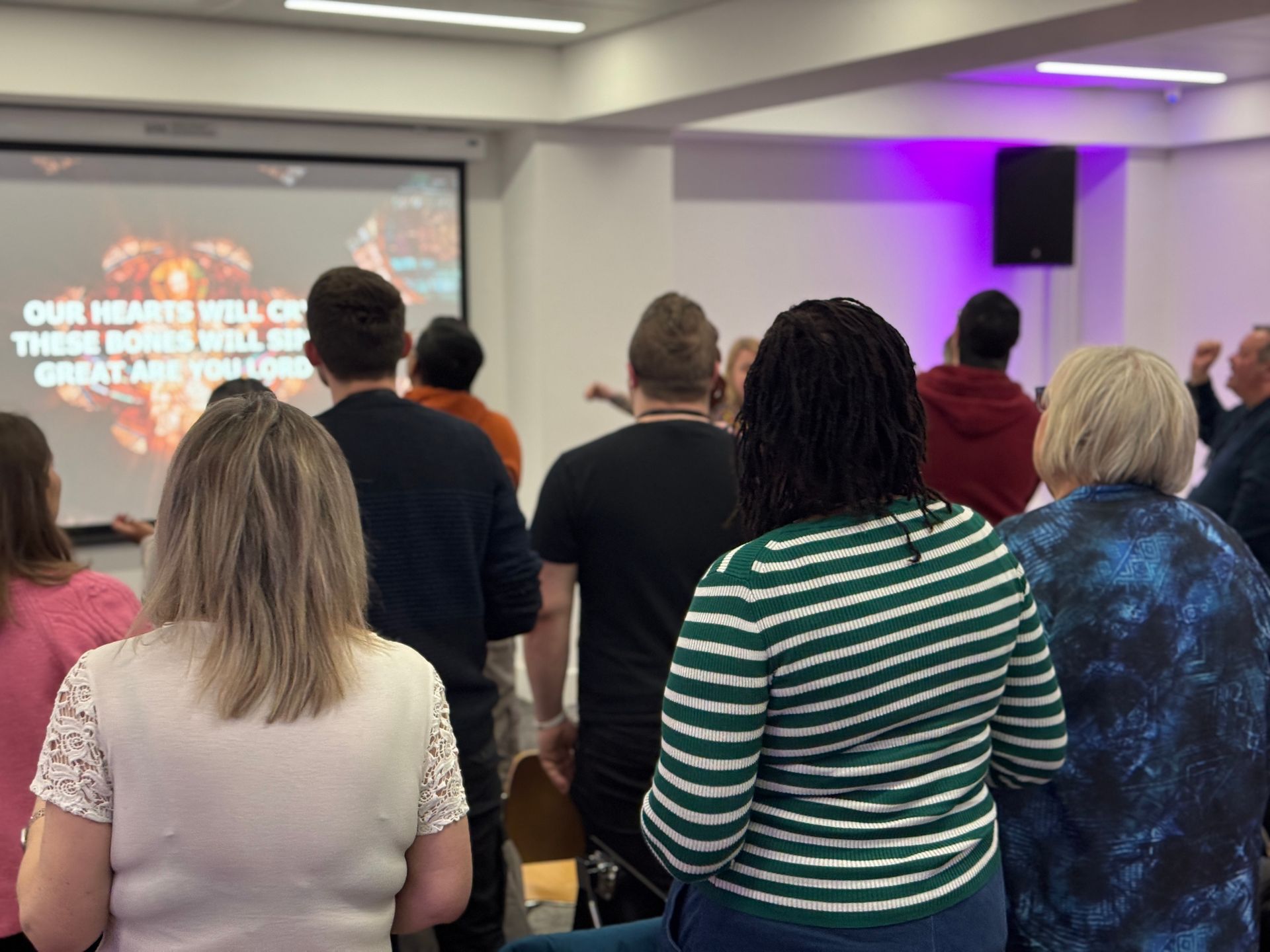
Cranmer is a worshipping community. We gather for prayer every day and Communion every week. Most Free Church students are not residential and many carry significant church leadership responsibilities outside college. But wherever you live, and however much time you can give — you are part of the community and that matters.
2. Mutual Discipleship
You are not just learning to do things. You are becoming someone. Every student joins a discipleship group — a small community where open, trusting, and accountable relationships are formed. These groups are the heartbeat of Cranmer's formational approach.
3. Tutoring and Mentoring
Every student has a personal Tutor. The tutorial is the space where academic work, ministry experience, walk with God, and pastoral concerns are reviewed together. Your tutor is a key companion on your leadership journey.
There are also opportunities for mentoring in ministry and leadership by members of the Cranmer team, many of whom have considerable experience in church and pastoral ministry.
4. Study and Learning
There is a rich learning environment at Cranmer. Lectures and seminars are the foundation, but study goes far deeper: reading the core and suggested texts for each module, taking notes, discussing ideas with colleagues and tutors, and writing assignments that develop your ideas and hone your analytical and reflective skills.

Frequently Asked Questions
Can I study part-time around existing ministry?
Yes. Many of our Free Church students study part-time. We have options from 60 credits (approximately two days per week) to full-time. We can also vary your credit load year by year if your circumstances change.
Do I need formal academic qualifications?
Not necessarily. We assess ability through multiple means and actively encourage applications from those whose qualifications come through life experience and church ministry rather than formal education. Get in touch for an honest conversation.
Can I start at Certificate level and progress to MA?
Yes — this is exactly the journey many of our students take. You start where you are; you progress as far as your calling requires and your ability enables.
I already have a degree in another subject. Where should I start?
Most students with non-theological degrees start at BA level to build solid theological foundations. This is wise preparation. Some with sufficient existing theological formation enter at MA level or begin with the Postgraduate Certificate.
How much time will it take?
A 20-credit BA module in something like Old Testament Studies or Christlike Leadership takes approximately 200 hours in total — around 30 hours of teaching sessions plus 170 hours of study, reading, reflection, and writing. Similarly, a 30-credit MA module takes approximately 300 hours. Cranmer's flexible study options allow you to plan a programme that genuinely fits your life and ministry.
A BA course is 120 credits each year. There are several ways to accomplish this, laid out within the table.
Term times are 10 weeks, shorter in the third term. Whilst there is no teaching outside of term time, you will find that your reading, study and writing continue.
| Certificate | Diploma | Degree | MA | |
|---|---|---|---|---|
| 2 days a week study | 2 years | 4 years | 6 years | 3 years |
| 3 days a week study | 3 years | 4 or 5 years | 2 years | |
| 4 days a week study | 1 year | 2 years | 3 years | 1 year |
What are the BA and MA entry requirements?
BA Entry
To start the BA course, you typically need A-levels at Grade C or equivalent. However, we strongly encourage applications from students who do not have formal qualifications but can demonstrate ability through other means — existing written work (reports, presentations) or completing an exercise such as a book review or a piece of biblical exegesis.
We often have students with degrees other subjects who start at BA level to build good theological foundations before progressing to MA level. Academic ability is not in question; but the theological foundations need to be laid.
We assess those with church-based or online theological training through a series of reflective questions. Our experience is these programmes generally take students to Certificate level — but often within a restricted theological range and without developed analytical or critical thinking skills.
MA Entry
We look for a Diploma or Degree in Theology with good marks, or the successful completion of our Postgraduate Certificate. If you have sufficient theological formation for the MA to be fruitful, but lack the formal qualifications, we enrol you on the Postgraduate Certificate. Marks from the Certificate carry directly into the MA — there is no repetition.
What will I study?
BA Programme — First Year Modules
In the first year of the BA, Free Church students typically take the following modules:
- Introduction to the Bible (Old & New Testament) — 20 credits
- Introduction to Christian Doctrine and History — 20 credits
- Mission and Evangelism — 20 credits
- Foundations for Denominational Ministry — 20 credits
- Missional Leadership Seminar — 20 credits
- Introducing Theological Reflection — 10 credits
- One elective (10 credits): NT Greek, Spirituality and Discipleship, or Introduction to Pastoral Care
Second- and third-year modules are chosen in consultation with your Tutor from a broad range of options designed to develop the full range of theological and ministry competencies.
MA Programme
The MA is built around a core module (Theological and Practical Reflection) and three elective modules chosen to suit your interests and areas of ministry development. The programme concludes with a 15,000-word dissertation. MA modules are available on the Durham University postgraduate module database.
Is Cranmer only for those being ordained or entering full-time ministry?
No. We train people for every level and type of ministry — ordained and lay, full-time and part-time, paid staff and voluntary. If you simply want to serve the church more effectively, Cranmer is for you.
What church traditions do your staff come from?
Our team brings together people from Anglican, Baptist, Pentecostal, New Church and other backgrounds. We are a genuinely diverse staff community, which is one of the reasons we can serve such a wide range of Free Church students well.
Who should I contact to find out more?
Email us at cranmer.admissions@durham.ac.uk
Cranmer Hall is comfortable in its own skin, gracious, kind, hospitable and caring.
Periodic External Review
Still have questions? Book a call
Either online or in-person, we’d love to talk more about how we can help you find your place at Cranmer Hall.